
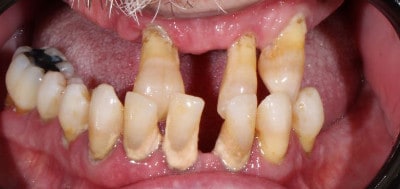
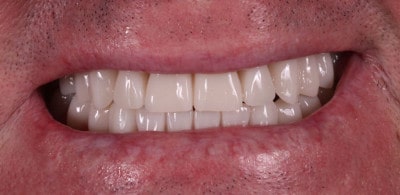




If you’re missing a couple of teeth, you’re probably not having the best time. It can make it super hard to snack on your favourite food. You might even feel a little bit anxious when you crack a smile, and that’s a hard no in our books. At Radiant Smiles Dental Care, we get what you’re going through. We want to help you take a look at your tooth replacement options, so you can get that beautiful smile shining again!
Key Takeaways
- Dental implants give you the most natural-looking solution while preventing jawbone loss.
- A dental bridge offers a fixed solution without surgery but requires altering adjacent healthy teeth.
- Full dentures are cost-effective, but typically need replacement every 5 to 10 years.
- Untreated gaps lead to shifting of remaining teeth, bone deterioration, and premature facial aging.
- Your ideal replacement option depends on your dental health, medical history, and budget.
Why Should You Replace a Missing Tooth?
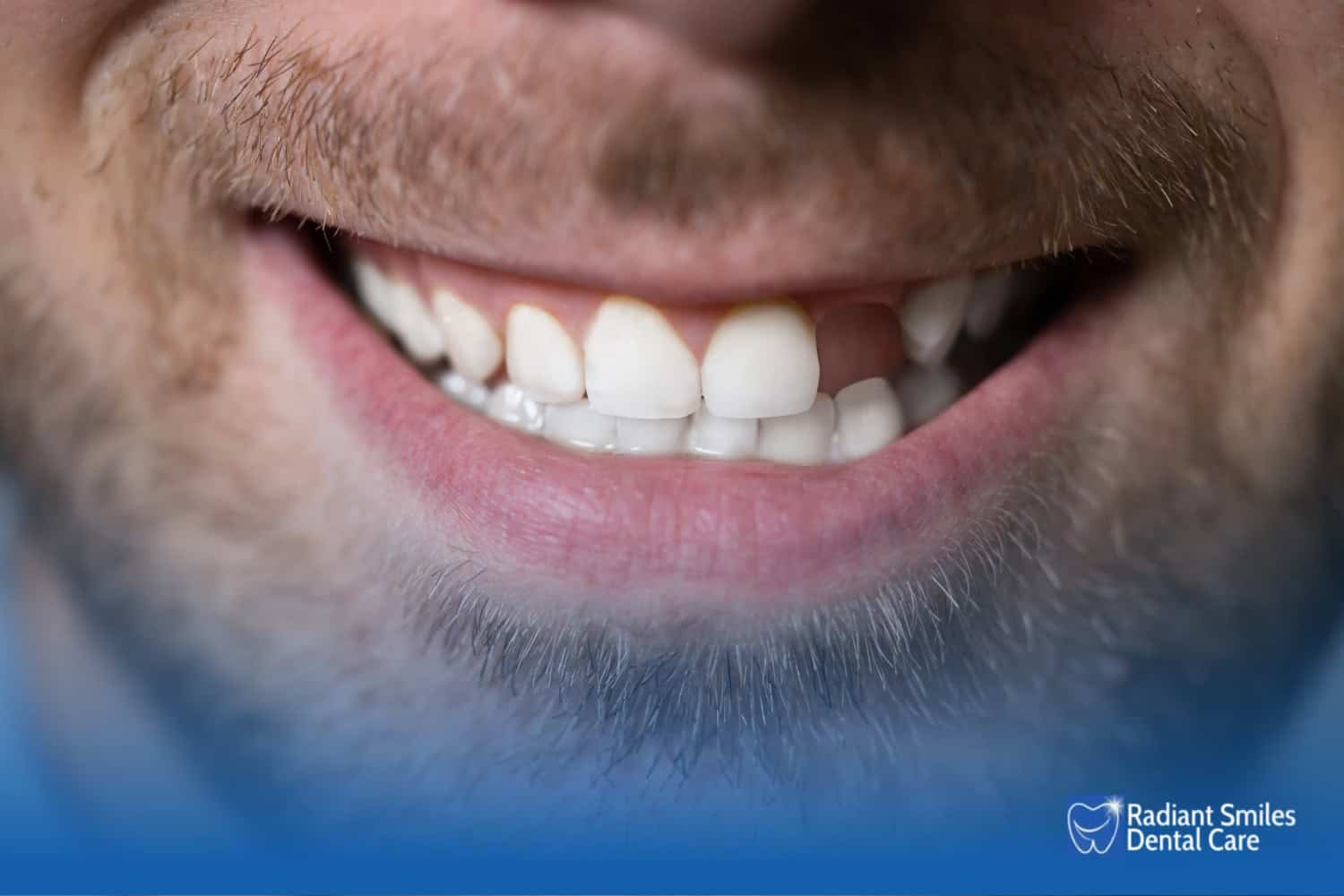 Tooth loss creates serious oral health issues beyond just appearance concerns. When teeth are missing, neighbouring teeth shift into the empty space, disrupting your bite alignment. Your jawbone requires stimulation from tooth roots to maintain density, with bone loss beginning immediately after tooth loss. Gaps in your smile can affect speech, limit food choices, and impact confidence.
How do Missing Teeth Affect Your Oral Health?
A missing tooth destabilises your entire mouth’s health. Surrounding teeth shift into the empty space, causing misalignment. These shifted teeth become more vulnerable to tooth decay as they’re harder to clean. The gap creates food traps where bacteria accumulate, increasing your risk of infections and further tooth loss.
What Happens to Your Jawbone When Teeth are missing?
Your jawbone deteriorates rapidly when natural teeth are absent. Teeth roots provide essential stimulation during chewing, signalling the body to maintain bone density. Without this stimulation, the bone resorbs and shrinks. This bone loss changes facial structure, creating a sunken appearance and premature ageing.
How does Tooth Loss Impact Your Appearance and Confidence?
Losing teeth visibly ages your appearance by altering the facial structure. Missing front teeth cause cheeks and lips to lose support, creating a collapsed look. Many patients develop habits like covering their mouths when speaking or smiling. These changes can impact job opportunities, relationships, and social engagement.
What are the Main Options for Replacing Missing Teeth?
If you’re wondering, “What options do I have to replace missing teeth?”, here’s a comparison:
| Replacement Option | Longevity | Cost (AUD) | Best For |
|---|---|---|---|
| Dental Implant | 20+ years | ±$3990 per tooth | Long-term solution |
| Dental Bridge | 7 to 15 years | ±$3,000 to $5,000 for 3-unit | Quick fixed solution |
| Full Dentures | 5 to 10 years | ±$3,600 | Complete tooth loss |
| Partial Dentures | 5 to 7 years | ±$1,200 | Multiple non-adjacent gaps |
How are Dental Implants Work?
Dental implants replace missing teeth using titanium posts surgically placed into your jawbone. These posts integrate with your natural bone through osseointegration, creating a permanent foundation. The replacement teeth implant consists of a titanium post, an abutment, and a dental crown that matches your existing teeth. According to GlobeNewswire, dental implants have become a leading choice for replacing missing teeth, with the global market estimated at $4.42 billion in 2023 and expected to grow to $5.88 billion by 2029.
Patients often tell us they’re surprised by how comfortable the procedure is to replace one or more teeth. As one of our clients, Jen, shared, “It was honestly less painful than having my wisdom teeth removed!”
- Endosteal implants: Placed directly into the jawbone
- Subperiosteal implants: Sit on top of the jawbone beneath the gums
- All-on-4 implants: Support an entire arch of new teeth
What is the Dental Implant Procedure Process?
Getting dental implants typically spans several months. Your journey begins with a consultation where we examine your mouth and take 3D images. The surgical placement itself is quick, usually under an hour for a single tooth replacement. During healing, the implant fuses with your jawbone, creating a strong foundation. Finally, we attach your custom crown.
What are the Advantages and Disadvantages of Dental Implants?
Dental implants offer exceptional benefits that make them a premium choice for tooth replacement. Here’s what you should consider:
Advantages:
- Look and feel like real teeth
- Preserve jawbone health and facial structure
- Can last a lifetime with proper care
- Don’t affect adjacent teeth
- Allow normal eating and speaking
Disadvantages:
- Higher initial cost than other options
- Require sufficient bone density
- Involve surgical procedures
- Several months’ completion time
- Not covered by Medicare
How do Dental Bridges Work?
A dental bridge consists of artificial teeth held in place by dental crowns cemented onto the abutment teeth on either side of the gap. The artificial tooth literally “bridges” the gap, restoring your smile’s appearance and functionality.
- Traditional bridges: Use crowns on adjacent natural teeth for support
- Cantilever dental bridge: Used when you have healthy teeth on only one side
- Maryland dental bridge: Use metal or porcelain wings bonded to adjacent teeth
What is the Dental Bridge Procedure Process?
Getting a dental bridge typically requires two to three appointments. First, we prepare the adjacent teeth by removing enamel to make room for the crowns. Next, we take impressions for creating your custom bridge. While this is being crafted, you’ll wear a temporary bridge. At your final appointment, we’ll fit your permanent bridge.
What are the Advantages and Disadvantages of Dental Bridges?
Dental bridges provide an effective fixed solution for missing teeth. Consider these factors when deciding if bridges are right for you:
Advantages:
- No surgery required
- Faster completion than implants
- Fixed, non-removable solution
- Prevents remaining teeth from shifting
- Maintains facial structure
Disadvantages:
- Requires altering healthy adjacent teeth
- Doesn’t prevent jawbone loss
- Typically needs replacement after 7 to 15 years
- Requires special cleaning techniques
How do Dentures Work?
False teeth (dentures) replace missing teeth with removable prosthetics that rest on your gums. These custom-made appliances consist of a gum-coloured acrylic base supporting artificial teeth designed to match your natural appearance.
What are the Different Types of Dentures?
Different types of dentures include full, partial, and implant-supported. Full dentures replace an entire arch of teeth and sit directly on your gums. Partial dentures fill in gaps when you still have some healthy natural teeth, using clasps for stability. Implant-supported dentures combine affordability with stability by snapping onto implants. Immediate dentures can be placed the same day as extractions.
What is the Denture Fitting Process?
Creating dentures involves taking impressions of your mouth, creating wax models for preliminary fitting, and making final adjustments. Many patients need time to adjust to their new teeth, with common experiences including increased saliva flow and adapting to speaking and eating.
What are the Advantages and Disadvantages of Dentures?
Dentures provide a cost-effective solution for replacing multiple missing teeth. Here’s what to consider:
Advantages:
- More affordable than other options
- No surgery required
- Can replace many or all teeth at once
- Easily removable for cleaning
- Quick production time
Disadvantages:
- Less stable than fixed options
- Reduced chewing efficiency
- May require adhesives
- Need regular adjustments and replacement
- Possible speech changes initially
How do You Choose the Right Tooth Replacement Option?
What are my options to replace missing teeth? The ideal option depends on your situation, lifestyle, and budget. At Radiant Smiles Dental Care, we take a personalised approach, considering factors like your medical history, the number, and location of missing teeth, bone density, and budget constraints.
Which Factors Should You Consider when choosing a Tooth Replacement?
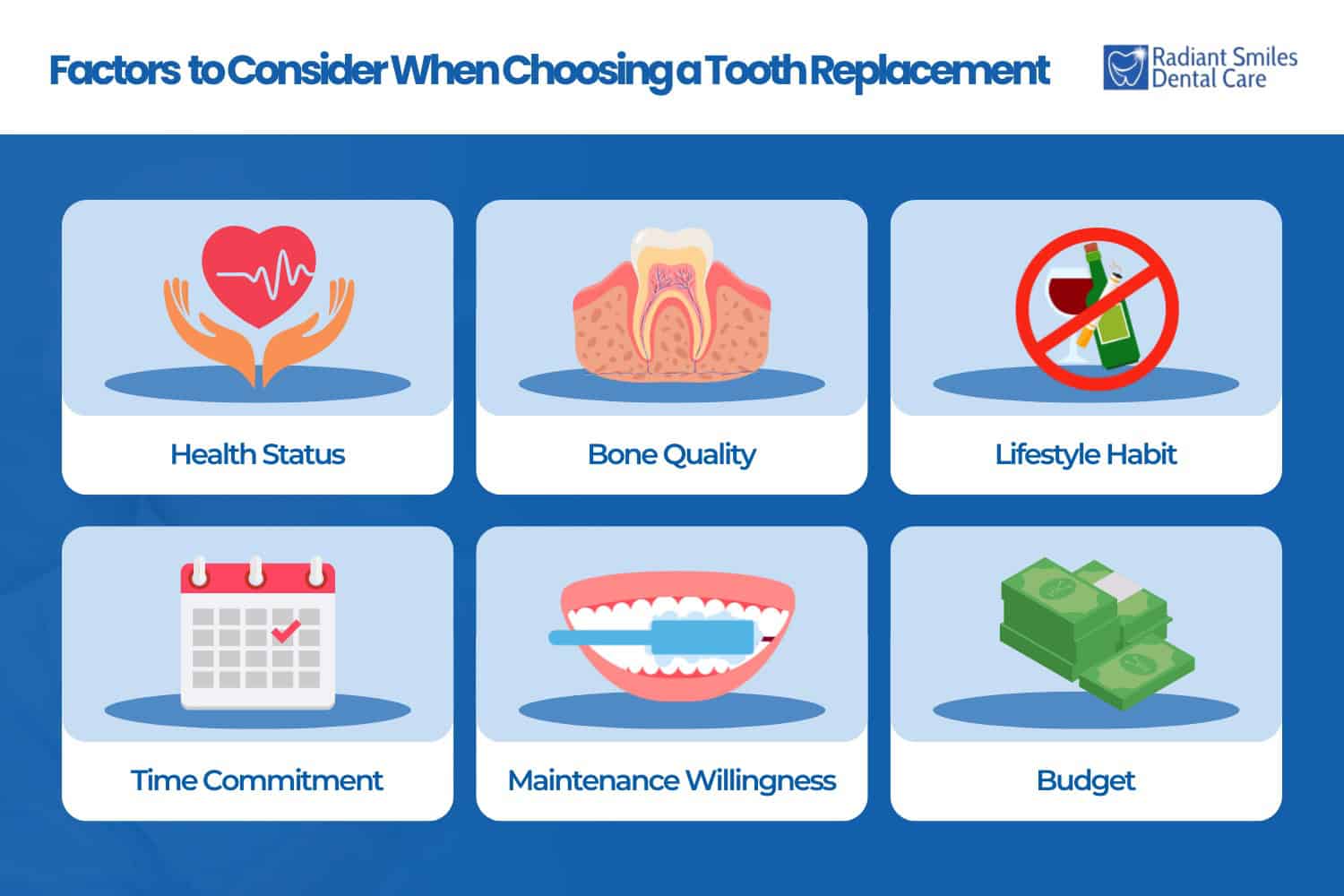
Your decision should consider:
- Health status: Certain medical conditions may affect healing
- Bone quality: Sufficient jawbone is needed for implants
- Lifestyle habits: Smoking can increase risks
- Time commitment: Some options require multiple appointments
- Maintenance willingness: Different options require varying care
- Budget: Initial costs versus long-term value
Which Option is Best for a Single Missing Tooth?
Replacing a single tooth is best accomplished with a dental implant. This option preserves jawbone health and prevents shifting of surrounding teeth. While a dental bridge can also work, it requires altering healthy adjacent teeth, which many prefer to avoid.
Which Option is Best for Multiple Missing Teeth?
When replacing multiple missing teeth, implant-supported bridges or partial dentures offer the best solutions. For adjacent missing teeth, an implant-supported bridge provides replacement without compromising healthy teeth. For non-adjacent missing teeth, precision partial dentures provide a cost-effective solution.
Your Next Steps to a Complete Smile
At Radiant Smiles Dental Care, we understand that missing teeth affect more than appearance – they impact confidence and quality of life. Our team in Perth and Albany will guide you through dental options to replace missing teeth, helping you choose the option that best fits your needs.
We’re committed to helping you find the perfect options to replace missing teeth. Contact us today to schedule a consultation.
FAQs on What are Your Options for Replacing Missing Teeth?
What Happens if I don’t Replace My Missing Teeth?
Leaving gaps untreated leads to serious complications. Your surrounding teeth will shift into empty spaces, causing bite problems. Without tooth roots stimulating the jawbone, bone loss accelerates, changing facial appearance and potentially impacting speech and nutrition.
How do I Care for My New Tooth Replacements?
Each replacement option requires specific maintenance: Implants need regular brushing and flossing like natural teeth. Bridges require special flossing techniques using threaders or water flossers. Dentures should be removed and cleaned daily, with gums gently brushed.
Can I Upgrade from Dentures to Implants Later?
Yes, many patients start with dentures and transition to implants when budget allows. At Radiant Smiles Dental Care, we design staged treatment plans that work with your timeline and finances, including options like implant-supported dentures that provide improved stability at a lower cost.
Back to Top: What are Your Options for Replacing Missing Teeth?